Learn how Wärtsilä achieved:
-
45% shorter time to market
-
43% less part numbers
-
50% reduced assembly lead time


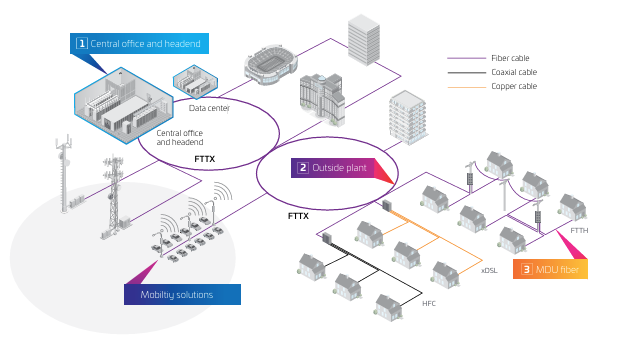
The pressure from the market, the need to reduce cost, and reduce development lead times were increasing and at the same time the mountain of complexity was growing out of control. In 2017 it became more and more apparent that the CommScope Broadband Networks business segment needed a new approach to the product offering and to product development.
To cope with these emerging trends CommScope needed a new design approach that could deliver on these three principles configurability, scalability, and simplicity. The conclusion from thorough research was to embark on a modularization program. The program would involve all relevant stakeholders and functions in the company from Sales to Production to create “the ability to offer the most configurations for connectivity with the fewest components “. CommScope chose to go with Modular Management creating a Modular Product Architecture for their next product launch.

To start the program a set of strategy workshops was conducted with the business segment management team to align on the vision and to identify the business value. When the strategy was aligned on a set of tangible implementation targets as well as a realistic implementation plan was created.
As CommScope traditionally is a very customer focused company with a lot of customer unique engineering it was clear that we needed to start with building a better understanding of the market needs. This was done by creating a needs-based market segmentation model.
The resulting segmentation model clarified the main customer types/behaviors and their priorities when selecting what to purchase but also supported CommScope in articulating the market priorities and the gaps in the product offering. The model was created by a cross functional team and validated and enhanced through interviewing customers and potential customers. The customer input gave insights to fine tune the segmentation model and the development priorities for the new product range.
The new market segments gave CommScope a direct means to communicate and make the priorities understood internally. It became the new language and platform to manage both the existing product range, the future product range as well as the sales and pricing principles per segment. A much appreciated first implementation step.
.png?width=250&height=197&name=Picture3%20(3).png)
With a well-defined strategic direction, clear targets and the market segmentation in place the work started to define the future product assortment and the corresponding product architecture. In parallel with this work a continuous process of involving executive management was applied. This to both secure support but also to be able to manage deviations and take timely decisions along the journey. The program was given the name HORIZON to enable consistent internal communication, and later on, the program as launched under the NOVUXTM brand to encompass all five terminals and closures families to be released within the platform.
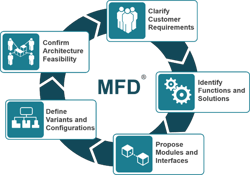
The creation of the modular product offering was done by a global cross-functional team using Modular Function Deployment (MFD®). The MFD® process gives good support in structuring the required information, identifying gaps and managing concept evaluation, concept selections in the early development phase.
CommScope was now ready for the next step: to start detailing the future global supply chain structure for the new modular product architecture. We put the principles and strategies in place for what, where and how to source raw materials and components, how to structure the manufacturing and assembly process as well as the order execution and delivery process.
A very important piece in succeeding with setting the right supply chain in sync with the product architecture is to work cross functionally and continuously align the product architecture with the supply chain requirements. To reach targets on lead time and product cost.
To take the defined supply and manufacturing concept to implementation CommScope enrolled a global team of specialists specifying and implementing improved production lines. They worked through the process of operationalizing the modular product architecture through all the required production technologies to secure flexibility, lean operation and short changeover times to maximize the value.
In this improvement process the number of suppliers could be reduced from 777 to less than 250. To reduce transportation distances the location of the suppliers was strategically selected with respect to the manufacturing locations. In addition, for improved resilience, two suppliers were selected per region, instead of the typical single supplier model used in the past. This results in a stabilized supply chain and a reduction in direct material cost as the volumes per supplier increase.
To fully harvest the value of driving the product range and associated activities enabled by a modular product architecture created the need to review and update the main processes as well as the tools for product development, sales to order and order to delivery.
Going back to the strategic direction and the program objectives, to reduce the sales to delivery lead time as well as support the customers and the sales force in finding the best solution in the new assortment a new configuration solution was required. As part of the overall program we identified the direction and objectives for what the configuration solution should fulfill. After a thorough evaluation a configurator solution tool was selected based on the right capabilities, good integration to the ERP system and suitable to manage the range of NOVUX™ products coming out of the product architecture.
The Broadband Networks business segment is the industry’s first modularly architected fiber-to-the-home (FTTH) platform, engineered from the ground up and end-to-end across the FTTH network was created and released under the new brand NOVUX™.
.png?width=750&height=105&name=Picture4%20(4).png)
Photo Copyright: https://www.CommScope.com/press-releases/2021/CommScope-debuts-novux-portfolio-of-global-fiber-deployment-solutions/
.png?width=185&height=287&name=Picture5%20(2).png)
Quote of Vice President Network Connectivity Business Unit at CommScope James DeCoe:
“With NOVUX™, we’re really leveraging CommScope’s expertise, innovation, and scale to bring our customers and their networks into the future. Our commitment to our customers means we use their direct feedback to help guide strategic decisions about our solutions and to ensure that every connection and cable is a revenue stream for their business. NOVUX™ is a great example of that. I’d like to thank the incredible team for putting so much into NOVUX™ and for continuing to advance the state of our industry.”
CommScope and NOVUX™ are trademarks of CommScope. More about the NOVUX™ brand can be found at: www.CommScope.com/NOVUX™
For further reading, we highly recommend "The Transformational Journey to a Modular FTTH Connectivity Ecosystem" by Commscope.
%20(12)%20(1).png?width=2000&height=640&name=MM%20Top%20site%20banner%20(1260%20x%201280%20px)%20(12)%20(1).png "CommScope Modular transformation joruney")

45% shorter time to market
43% less part numbers
50% reduced assembly lead time
40% less part numbers
25% shorter time to market
1+ billion in added shareholder value
50% reduced design cost
25% faster construction time
50% less on-site indirect cost