Laboratory automation is undergoing a phase of profound transformation. Automated systems have long been indispensable for research, diagnostics, and life-science applications, and demand continues to grow steadily. At the same time, companies along the entire value chain – from sales through development and production to service – are coming under pressure. Customers expect solutions precisely tailored to their needs – fast, individual, and at competitive prices.
This development opens up opportunities, but it also increases the pressure on companies. The trend toward individualization brings a central challenge: with every additional product variant, internal complexity and costs rise. Many companies thus find themselves caught between external variety and internal efficiency: on the one hand, they need to achieve broad market coverage with customer-specific requirements; on the other, the end-to-end processes along the value chain must be designed to remain manageable and economically viable.
Recording from Smart Variant.CON 2026 (June 24, 2026, Berlin)
In his 20-minute solution study, using the example of laboratory automation, Dirk Beckmann demonstrates that it is not the customer's needs that are complex, but rather the way companies choose to address them. Guided by the framework of "WHY," "HOW," and "WHAT," he explains how modularity decouples external variety from internal complexity. He further explores why the "Configure-to-Order" (CTO) stage serves as the strategic pivot point between standardization and individualization—spanning the spectrum from STO (Standard-to-Order) and CTO to CTO+ and ETO (Engineer-to-Order)—and outlines the necessary shifts across products, processes, IT landscapes, and organizational structures required to transform modularity into profitable growth.
Please note that the recording is in German, auto-translated subtites are available.
Between Standard and Custom Solution: The Scaling Dilemma of SKU, CTO+ and ETO
While Configure-to-Order Plus (CTO+) and Engineer-to-Order (ETO) enable tailor-made solutions, they are only scalable to a limited extent in the long run. With every new order, the effort along the value chain grows disproportionately. The resulting special solutions tie up valuable development resources – and can rarely be transferred to other customers. At the other end of the spectrum are standardized Stock-Keeping-Units (SKU) in the form of ready-made solutions. They enable high scalability and efficiency but cover only limited market needs – while CTO+ and ETO solutions win through higher prices and customer proximity, yet are less scalable.
The first figure establishes a common vocabulary and defines the four Business Transactions: SKU, CTO, CTO+ and ETO.
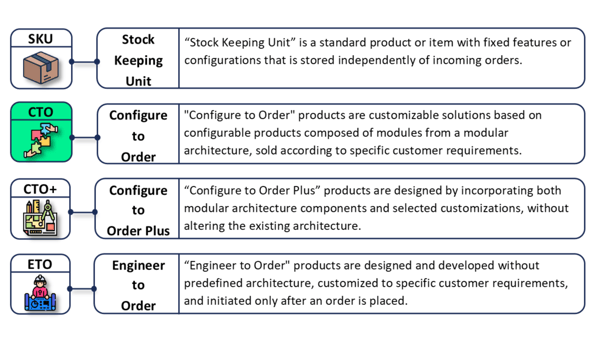
Figure 1: The four Business Transactions SKU, CTO, CTO+ and ETO
The second figure shows how, along the end-to-end process, the share of customer-anonymous development shifts toward order-based engineering – and that with CTO+/ETO, both project risk and lead time increase. At the same time, customer-specific solutions are coming under growing price pressure – customers increasingly compare them with standardized products, even though they require considerably more development effort.
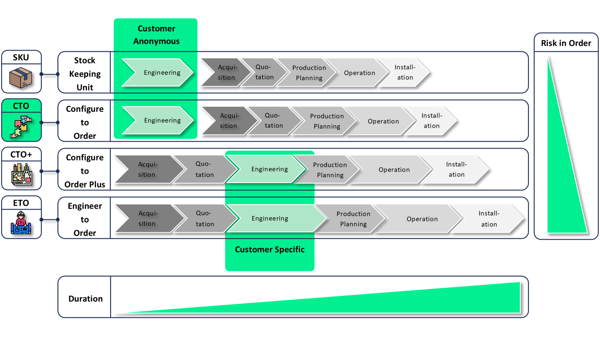
Figure 2: Customer-anonymous and customer-specific development in the end-to-end process
The Way Out: Modular Product Architectures and Configure-to-Order (CTO)
The core principle of modular product architectures is simple: a clearly structured module base with standardized interfaces forms the foundation for a multitude of possible variants. As with Lego, countless configurations emerge from a limited number of building blocks. In laboratory automation, this means: variety is created market-driven at module level, while the interfaces act as fixed guardrails that keep the architecture lean. This makes it possible to achieve broad market coverage with a single, consistent base architecture – without having to develop from scratch every time.
The true lever of modular architectures lies in their scalability:
-
Reuse instead of redevelopment: Modules are developed once, customer-neutral, and then deployed in different combinations. New customer-specific requirements are incorporated into the kit – wherever possible – as generic extensions. The number of possible customer solutions grows without development effort or resource use rising proportionally.
-
More orders without longer delivery times: Since individualization is achieved through configuration rather than redevelopment, quotation and delivery times remain stable even as order volumes grow. The result: more customer orders in less time.
-
Parts efficiency through modular structure: Standardized interfaces enable the reuse of components across modules. Parts variety decreases while volumes per component increase – procurement, warehousing, and assembly become more efficient.
-
Faster market response and lower project risk: New requirements can be implemented by adding or exchanging individual modules without touching existing systems. Integration effort, error-proneness, and time-to-market all decrease.
Ultimately, this scalability means more than efficiency: it creates the foundation for profitable growth – because increasing variety no longer automatically means increasing costs.
The following diagram illustrates how the various Business Transactions – ETO, CTO+, CTO and SKU – differ in terms of complexity and degree of individualization. While ETO and CTO+ stand for customer-specific special developments with high complexity and SKU represents fully standardized products, CTO marks the decisive transition point: it connects the two worlds of standardization and individualization.
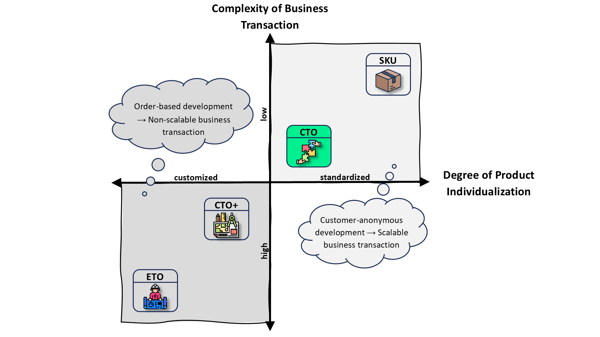
Figure 3: Degree of individualization and complexity of the Business Transactions – CTO as the transition point
Modularity is not only the foundation for manageable variety, but also the starting point for strategic decisions along the entire value chain. In manufacturing, it becomes particularly clear how closely product architecture and production strategy are intertwined.
Global Manufacturing Footprint: Manufacturing Strategies in the Context of Modular Architectures
So far, the modular product architecture has been the focus: it forms the basis for how variety is created market-driven at module level and how internal complexity remains manageable through standardized interfaces. For modularity to unfold its full effect in practice, however, it must be linked to the right manufacturing strategy.
Central to this is the relationship between the Business Transactions (SKU, CTO, CTO+, ETO) and the corresponding manufacturing strategies (MTS, ATO, MTO):
-
Make-to-Stock (MTS): Finished end products are produced to stock. This strategy is fast and cost-efficient but suitable exclusively for standardized SKUs.
-
Assemble-to-Order (ATO): Modules are pre-produced independently of the customer and only configured and final-assembled after order intake. It is the ideal manufacturing strategy for CTO and modular product architectures, as it combines efficiency and customer proximity.
-
Make-to-Order (MTO): Production starts only after order intake. This offers maximum flexibility but comes with long delivery times and higher planning and engineering complexity.
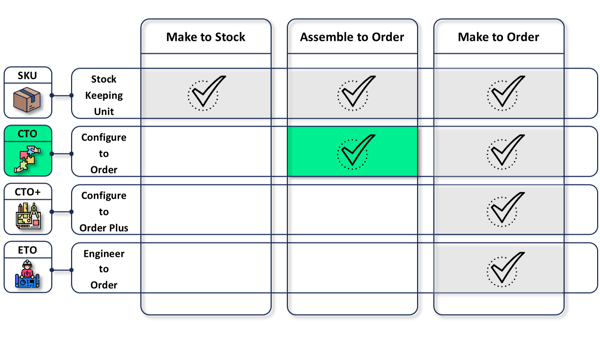
Figure 4: Manufacturing strategies MTS, ATO and MTO per Business Transaction
A key factor in Assemble-to-Order is the Customer Decoupling Point – the moment at which the process transitions from customer-neutral to customer-specific value creation. Best practice shows: the later this point lies, the higher the efficiency. Standardized processes up to final assembly ensure repeatability and stability, while individualization takes place only at the end – through configuration.
The Customer Decoupling Point determines when individualization begins in the value chain. Just as decisive, however, is the question of where the modules are manufactured and with what manufacturing depth. When building a modular product architecture, it is therefore a central cornerstone to structure the modules along the three axes of Operational Excellence, Customer Intimacy and Product Leadership. The result is the Global Manufacturing Footprint – the mapping of which modules are manufactured at which sites and with what focus.
-
Operational Excellence: Modules with low variance, high automatability, and large volumes – ideal for centralized, standardized production.
-
Customer Intimacy: Modules with high variance and labor-intensive processes that are difficult to automate. They are often manufactured at sites with competitive cost structures and high flexibility.
-
Product Leadership: Modules with high innovation density and demanding technology requirements. They need specialized production lines and proximity to research and development.
The modular product architecture thus becomes the guiding principle for the supply chain strategy. Standardized high-volume modules can be bundled in centralized, highly automated production. High-variance, labor-intensive modules are mapped to cost-optimized structures, while premium modules with a high degree of innovation are built at specialized sites that offer the necessary technological know-how and proximity to research and development.
But modularity does not end in manufacturing. It also plays a central role in the digital representation of the value chain – especially in the underlying processes and systems.
Digital Thread instead of data silos: How modularity becomes scalable
For modularity to be effective in practice, it needs an end-to-end digital representation – a consistent data model that connects development, sales, and manufacturing across the entire lifecycle.
At the center is the Digital Thread: it links product architecture, processes, and systems into a continuous flow of information, making variety manageable.
Its most important building blocks are:
-
PDM (Product Data Management): This is where product structures, modules, and variants are maintained.
-
ERP (Enterprise Resource Planning): Controls planning, manufacturing, and logistics.
-
CPQ (Configure, Price, Quote): Translates customer requirements into concrete quotations and bills of materials.
-
ALM (Application Lifecycle Management): Ensures consistency and traceability in development.
The following diagram shows how system relevance differs by Business Transaction.
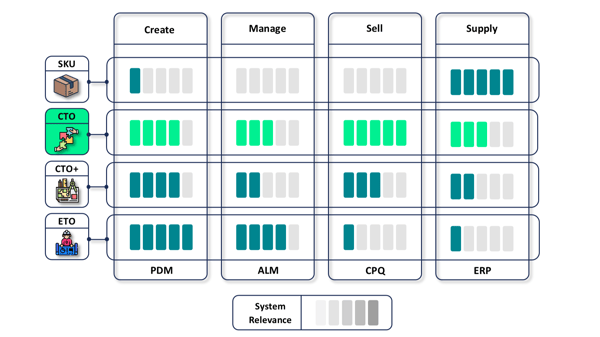 Abbildung 5: Systemrelevanz von ALM, PDM, CPQ und ERP je Business Transaction
-
For SKUs, the ERP dominates – standardized processes are the priority here.
-
For CTO, the close integration of PDM, CPQ, and ERP is decisive in order to configure variants efficiently.
-
For CTO+ and ETO, data ownership increasingly lies with PDM and ALM, as development and design data take center stage.
This mapping, however, describes ideal types. In practice, the boundaries often blur – especially in regulated industries such as medical technology. There, even the production of standardized SKUs can be strongly ALM-driven, because strict regulatory and documentation requirements demand end-to-end traceability across the entire product lifecycle.
Despite these industry-specific differences, one principle holds: every Business Transaction follows its own data model and requires a specific system architecture – from the fully integrated ERP process to the PDM-driven engineering workflow.
Only when these system landscapes are deliberately aligned does a consistent end-to-end process emerge – one that makes variety manageable and enables profitable growth.
Modularity thus becomes not only a product principle but the digital backbone of the organization – the connecting element between the product, process, and system worlds.
Great – but How? Optimization or Transformation
This is where the loop closes: Great, but how? Impact emerges when modularity is understood not as an isolated project but as a company-wide way of working – as the coordinated interplay of Product, Process, IT-Landscape and Organization.
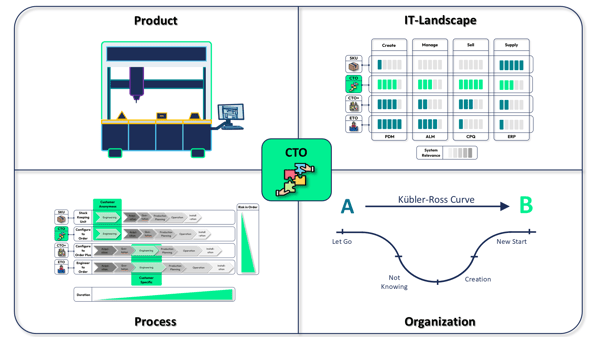
Abbildung 6: Das CTO-Operating-Model – Zusammenspiel von Product, Process, IT-Landscape und Organization
-
Product: A modular product architecture with standardized interfaces, high parts efficiency, and clear configuration rules forms the stable basis of variety.
-
IT-Landscape: A consistent data model aligned to each Business Transaction and the integration of PDM, CPQ, and ERP – central to CTO – act as digital enablers.
-
Process: Value-based selling in sales, standardized interfaces in the innovation process, and clear guardrails for new part creation ensure efficiency and repeatability.
-
Organization: Clear structures (e.g., module or platform owners), defined rules (variant governance), and lived behavioral anchors: leadership embeds modularity in day-to-day work, and teams are enabled through training and mentoring.
This article focused primarily on Product and IT-Landscape. The lasting effect, however, only emerges when Process and Organization are consistently brought along too. Companies should deliberately assess how many levers need to be moved at once – and whether they are dealing with a targeted optimization or a comprehensive transformation in which portfolio, processes, systems, and organization are realigned.
In this way, modularity evolves from a product principle into the backbone of the organization: it makes variety manageable, processes repeatable, and growth profitable – combining market leadership with true customer proximity.
Whether the approach works is shown by measurable results: a growing CTO share of revenue, shorter lead-to-ship times, decreasing parts variance with simultaneously greater market coverage, falling error and quality costs with rising margins, and a significantly shorter time-to-market for new variants and applications.
Conclusion: Modularity is not a pure engineering topic but a business model upgrade. When Product, Process, IT-Landscape, and Organization are jointly aligned to Configure-to-Order – supported by clear governance, a robust Digital Thread, and leadership that actively shapes the change – variety grows without complexity exploding. Precisely therein lies the path to scalable, profitable growth in laboratory automation.